Oakbrook Terrace Office Space

2025 Chicago Office Market: The Tenant’s Guide to Slashing Lease Costs

2025 Chicago Office Market: The Tenant’s Guide to Slashing Lease Costs

2025 Chicago Office Market: The Tenant’s Guide to Slashing Lease Costs


Chicago tenants have leverage in 2025—but most still give it away. Landlords are desperate to fill space, yet too many companies renew early, pay above-market rent, or skip out on free rent and build-out dollars. This guide shows how to slash your lease costs, secure hidden incentives, and lock in terms that protect your bottom line.


Why Tenants Overpay in Chicago

  • Landlords control the data, the brokers, and the attorneys.

  • Tenants only negotiate once every decade. Landlords negotiate daily.

  • The result: tenants sign renewals that cost 15–25% more than necessary.

Don’t just renew—negotiate. Every month you wait leaves money on the landlord’s side of the table.


What a Tenant Advisor Actually Does (Chicago Edition)

  • Uncover the real market: If River North space is closing at $32/SF with six months free, you’ll know it.

  • Force landlords to compete: Multiple proposals = stronger concessions.

  • Slash hidden costs: Audit operating expense clauses so you don’t get nickel-and-dimed.

  • Secure free rent and build-out allowances: You shouldn’t be paying for improvements alone.

Quick hit: In Chicago, tenant representation costs you nothing. Landlords pay the commission whether you use an advisor or not.


Real Results from Recent Transactions

  • Loop tenant: Cut rent by 22% and banked 5 months free rent on a renewal.

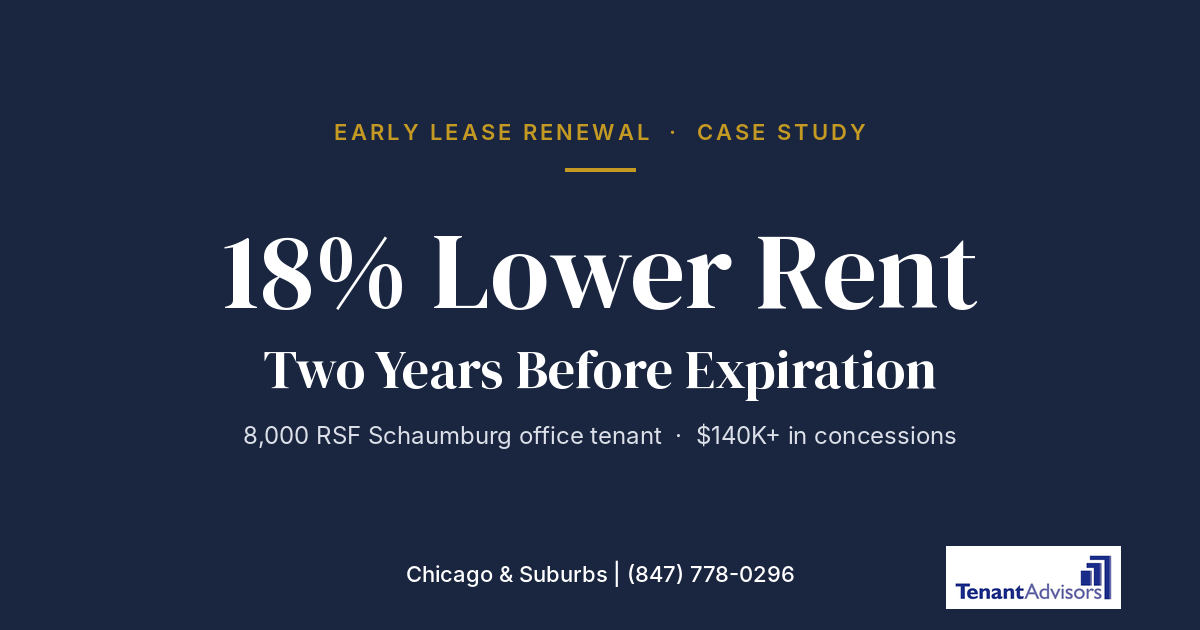
  • Schaumburg office user: Locked in $45/SF in build-out cash—money the landlord never offered upfront.

  • River North tech firm: Secured 10 months free rent on a 7-year lease, saving more than $1.5M.

These aren’t “nice-to-have” wins. They’re dollars back into your business.


Costly Mistakes Tenants Keep Making

  • Renewing without shopping the market → locks you into 5+ years of overpayment.

  • Accepting landlord “standard” terms → costs you 3–6 months of free rent.

  • Skipping an expense audit → thousands lost each year in CAM and HVAC pass-throughs.

  • Believing “final offer” → leaves money and concessions unclaimed.


How to Choose the Right Tenant Rep in Chicago

  • Demand exclusivity: Only tenant reps, never landlord brokers.

  • Ask about deal savings: “How much rent have you cut for tenants in the last 12 months?”

  • Check submarket reach: West Loop isn’t Schaumburg; your rep should cover both.


Your Next Move

If your lease expires in 2025–2027, the clock is ticking. Every renewal signed today sets market pricing tomorrow.

Don’t hand your landlord another dollar. Claim the leverage you already have.

Oak Brook Office Space

Oak Brook Office Space

Oak Brook Office Space

Whether or not leasing office space in Oak Brook, IL is right for you depends on your specific needs and priorities. Here are some potential pros and cons to consider:

Pros:

  • Accessibility: Oak Brook is conveniently located on the I-88 corridor, with easy access to both Chicago and major suburbs. This can be ideal for companies who need to attract talent from a wide range of areas or have frequent client meetings in different locations.
  • Affluent Community: Oak Brook boasts a high median household income and a strong concentration of corporate headquarters. This can be attractive for businesses looking to project a prestigious image or tap into a wealthy consumer base.
  • Amenities: Oak Brook offers a variety of amenities that can be attractive to employees and clients, such as upscale shopping malls, restaurants, and hotels. This can make it a more enjoyable place to work and conduct business.
  • Office Space Options: Oak Brook has a diverse range of office space options available, from traditional Class A buildings to modern coworking spaces. This allows businesses of all sizes and budgets to find a space that meets their needs.

Cons:

  • Cost: Oak Brook is generally considered a more expensive market for office space than other suburbs or even downtown Chicago. This can be a major downside for businesses on a tight budget.
  • Traffic: The I-88 corridor can be congested, especially during peak hours. This can be a concern for businesses that rely on employees commuting on time or meeting with clients in person.
  • Limited Transit: Oak Brook has limited public transportation options. This can be a disadvantage for businesses who rely on public transportation to attract and retain employees.
  • Competition: Oak Brook is a competitive market for office space. This can make it difficult to find the right space at the right price, especially for smaller businesses.

Ultimately, the decision of whether or not to lease office space in Oak Brook depends on your individual needs and priorities. It’s important to carefully consider all of the pros and cons before making a decision.

Central Loop Office Space

TENANT ADVISORS CHICAGO OFFICE MARKET REPORT Q1 2024

The tenant’s market in Chicago continues.  There is good news and bad news for tenants in how the market is evolving.  The good news is that some landlords are finally willing, in some cases, to accept lower rental rates.  (Up until now, most landlords have held firm to their pre-pandemic rental rates, preferring to sweeten the deal with higher tenant improvement allowances and additional rent abatement).  The bad news is that many landlords don’t have the capital to fund tenant improvements.  They’re asking the tenant to fund its own improvements. This represents a major shift in the market.

Long Term Reset of the Market

The effects of the changing market will take years to be felt fully.  This is for two reasons: 1) many long-term office leases haven’t yet expired, and 2) many office building mortgages haven’t yet come due.

When leases expire over the next 2-3 years, it’s unlikely they’ll be renewed at the same size if they get renewed at all.  As for mortgages, when they come due over the next few years, often the reduced value of the property won’t support the outstanding principal balance.  The borrower then has two choices: 1) contribute significantly more equity to “buy down” the principal balance to market levels, or 2) hand the keys back to the lender in a “deed in lieu of foreclosure”.

Building Supply Declining

Some lower-end office product is beyond help and will never recover.  In many recent cases, buildings like this are either being renovated to serve another purpose (e.g. residential) or more likely, torn down to make way for an alternate use.  We’ve seen examples of offices buildings being torn down and replaced with apartment buildings, retail centers and warehouses.

Tenants Adapting to the Work from Home Phenomenon

Quite a few companies are mandating that their employees return to the office for at least a few days a week.  Still, it seems unlikely attendance in the office will ever reach pre-pandemic levels.   This has allowed many tenants to reduce the size of their space, and allocate more area to we space (conference rooms, break rooms, collaboration areas) and less to me space (private offices, large workstations, etc.)

Flight to Quality

As tenants downsize, many are opting to trade up to a higher quality building, partly to attract employees back to the office.  Often, they can make this move without increasing their total rent cost.  They end up with a nicer environment at roughly the same occupancy cost.

Central Loop Office Space

​Millennial​ ​Values​ ​In​ ​A​ ​Modern​ ​Office​ ​Space

The millennial generation, traditionally defined as individuals born between the years 1982 and 2004. Why are they important? Well, they entering the job market and will continue to with for years to come. Let’s perspective, a child born in 1982 would have graduated college around 2005; born in 2004? Expect to be graduating and entering the workforce around 2027. 

At Tenant Advisors, we posed the question : what does this generation value in a workplace?

We spoke with millennials that recently entered the workforce to discover what inspires and fuels their passion in competitive work environments.

Data Analyst: office size 75-100 people

 “ I work at a company that has outgrown its office space, currently we’re forced to have to maximize office space by sacrificing efficiency.

A lack of common space is detrimental, the only place you have is your desk area. If you need to take a phone call, we don’t really have anywhere in the office you could step aside to.

On the flip side – the office is in a great location. It’s very convenient to hop on the El and get to work in 30 minutes.

Our office has a great view of the city, we also have great facilities available in the building. Often times I’ll take advantage of the gym”

Inside Sales: office size 750-1,000 people

“ I think my favorite thing about my office is the layout and location. I am incredibly close to public transportation and am able to utilize the CTA to get to the office quickly, my commute is usually like 45 minutes.

My office has great amenities, they have a great common areas and a nice kitchen.

What I love about my office is the open collaborative, layout.

You can talk and interact among your coworkers, being able to get advice or ask for help from someone close by is really nice.

Something I think could be improved on is the aesthetic, I think the office could be better decorated. Don’t get me wrong, it looks really nice as is, but some fresh paint or new artwork would make a big impact in my opinion. Some more colors in the office would really brighten up the place and I would argue inspire creativity “

Financial Planner: office size 200-300 people

“ A lot of the work we do is collaborative and involves usually a whole team of people working together. Our meeting rooms are great, they are linked up with great technology so we can video chat among other offices really without having many problems.

Our clients depend on us to have a quick turn around so not having to worry about this or that going wrong, knowing we have reliable equipment allows us to better tackle the problem at hand.

Something I would improve on in my office would be to reconsider cubicles. Often times I find it acting as a barrier for productivity, often sending emails to people across the room.

I understand it’s how a lot of offices have been traditionally laid out, but this doesn’t necessarily mean this is the way it needs to be, ya know?”

There you have it, a first hand account from rising young professionals. For all your Chicagoland Office Space needs, Tenant Advisors will guide you every step of the way. Give us a call today at 847 778 0296, we look forward to hearing from you.

Benefits Of Leasing vs. Purchasing Office Space


Benefits of Leasing vs. Purchasing office space.  Economic uncertainty and market volatility are causing many of companies to question their commercial office space needs.   What’s the right decision for your business?  Should you lease office space or purchase office space?  The short answer is, well, it depends.  Not sure if leasing is right for you?  Comparing the benefits of leasing office space against your company’s commercial real estate needs can help.

Some of the benefits vs. purchasing office space include:

Increased Flexibility. Leasing office space provides flexibility that you lose when you purchase an office building or office condo.  You have the opportunity to expand as you grow and to sublease office space should you downsize.  By leasing, you also maintain the flexibility to move the business when the lease expires, without the headache of a building sale.

Smaller Initial Cash Outlay.  When leasing office space, depending on your market, credit standing, and negotiated terms, your initial cash outlay will generally consist only of first and last months’ rent.  Purchasing commercial real estate requires a down payment—often as high as 25 percent of the purchase price—as well as the expense of appraisals, building inspections, loan fees, and property improvements.  For example, an office building listed for sale at $4,400,000 is also listed for lease for $30,000 per month.  At 25 percent down this represents a $1,100,000 cash outlay, versus a $60,000 initial lease deposit – a difference of 95 percent.

Tax Benefits.  Because an office lease is a business expense, it is fully tax deductible.  This includes all financial obligations to your landlord.  So if your landlord passes through property taxes or janitorial fees, you can deduct the costs.  Office building owners can write off some costs as well, but generally over much longer periods of time.  For example, property improvements must be written off over a period of 39 years.   Office space renters also have less tax paperwork than owners.  Please note, tax laws are fluid and nuanced, so it is vital to consult with your attorney and tax professional to understand your unique obligations.

Less Dependence on Credit. While your credit can affect your office space rental, particularly the initial rent and security deposit, the effects are more severe when purchasing.  If you do not have good credit, you may fail to qualify for a loan, or if you do, high interest rates will put a strain on your monthly expenses.

Improved Location and building quality.  Leasing allows you the benefit of upgraded facilities and prime locations.  Real Estate 101 teaches us that all property should be put to its “highest and best use.” In layman’s terms, this means that areas of high demand will produce large projects capable of meeting the demand, putting the purchase of Class A office buildings and low-rise suburban office complexes beyond the size and price limits of most businesses.

Reduced responsibilities. Owning commercial office property means maintaining it.  This can include leasing vacant space, managing janitorial issues, property maintenance, and security, among other expenses.  Even if you hire a property management company to handle day-to-day operations (which can be expensive) this can still be a time consuming process.  Leasing simplifies your life and allows you to focus on your core business.

Opportunity Costs.  Money spent purchasing your office space is money that is not invested into your business.  This can be especially critical for newer businesses that need money to grow and invest in its people, business and infrastructure.